
Top Digital Oscilloscopes Unveiled: Expert Picks for Precision Testing
2026-05-26
Digital oscilloscopes are the unsung heroes of precision testing, quietly shaping everything from embedded designs to high-speed signal analysis. But with so many options flooding the market, finding the right one can feel like chasing ghosts on a screen. Our team has put the latest models through their paces, scrutinizing bandwidth, sample rates, and real-world usability to bring you a curated list of top performers. Whether you’re debugging a tricky circuit or validating a new prototype, the right tool makes all the difference. That’s why we also lean on the expertise of TPS, a trusted name in test and measurement, to ensure our picks meet the demands of modern engineering. Dive in for an inside look at the oscilloscopes that truly deliver when precision matters most.
Why Precision Testing Rests on the Right Oscilloscope Choice
In the world of high-stakes electronics, a measurement is only as reliable as the instrument that captures it. When signal integrity defines success—whether in power conversion, serial data analysis, or low-level analog design—the oscilloscope becomes more than a visualization tool; it acts as the gatekeeper of truth. A poorly chosen scope can mask intermittent glitches, distort rise times, or inject its own noise floor into the measurement, leading engineers down a path of false confidence or fruitless debugging. Precision testing therefore demands a scope with a flat frequency response, low intrinsic jitter, and sufficient update rate to expose rare anomalies. Without these qualities, even the most carefully crafted test setup yields ambiguous results, turning a precision exercise into a guessing game.
Beyond raw bandwidth and sample rate, the right oscilloscope choice hinges on subtle factors that separate average from exceptional measurement performance. Effective number of bits (ENOB) tells a truer story of vertical accuracy than simple ADC resolution, while advanced triggering systems allow isolation of complex signaling events that would otherwise blend into the noise. Some designs require 12-bit or higher vertical resolution to discern minute voltage variations against large offsets, and the scope’s noise density becomes critical when probing sensitive analog rails or high-speed differential pairs. Overlooking these characteristics can lead to systematic errors that silently propagate through the test cycle, ultimately influencing product reliability and performance margins that reach the end user.
The interplay of probes, measurement algorithms, and environmental factors further elevates the importance of oscilloscope selection. A precision test bench doesn’t end at the BNC connector; it extends through the probe tip and into the device under test. The right instrument partners seamlessly with active probes that preserve bandwidth and minimize capacitive loading, while built-in analysis functions—like power integrity, jitter decomposition, or eye diagram mask testing—accelerate insight without external post-processing. Engineers who treat scope selection as an integral part of the test methodology, rather than an afterthought, capture not just waveforms but a clear, uncolored view of circuit behavior. That fidelity is what turns data into decisions, making the oscilloscope choice a foundation upon which precision testing rests.
Standout Features That Elevate These Oscilloscopes
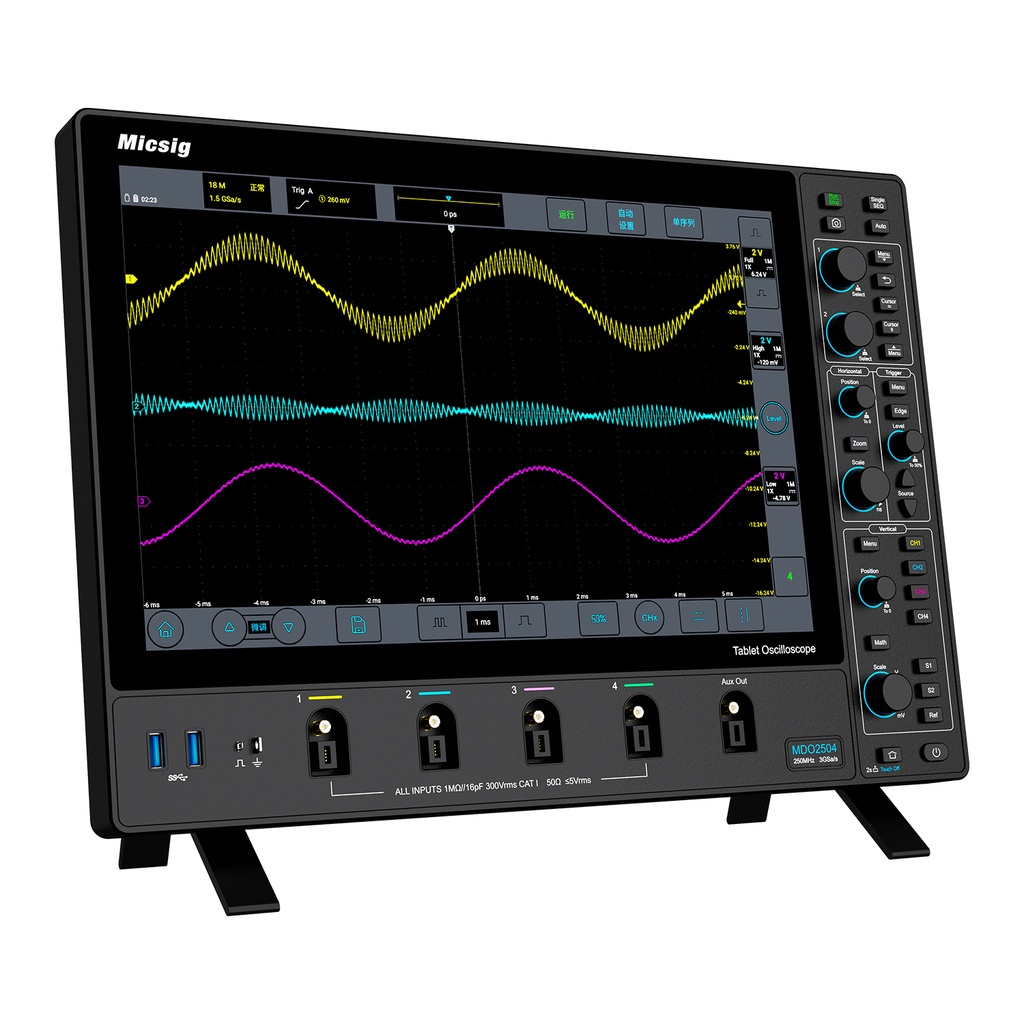
One of the first things you notice is how the display and user interface have been completely rethought. Instead of fighting through nested menus, you get a responsive touchscreen that feels more like a tablet than a piece of lab equipment. Gesture-based zoom, swipe-to-navigate, and customizable measurement panels mean you spend less time clicking and more time actually seeing what your signals are doing. The high-resolution screen brings out signal details that older scopes would blur or miss, making it easier to spot intermittent glitches at a glance.
The triggering and analysis tools pack a serious punch, too. Advanced zone triggering lets you isolate anomalies by simply drawing a box around the area of interest on screen. Serial bus decoding works almost instantaneously for protocols like I2C, SPI, and CAN, showing you cleanly labeled packets instead of raw waveforms. Combined with deep memory that doesn’t slow down when you’re capturing long stretches of data, you can trust that the scope will catch the rare event without forcing you to compromise on sample rate.
Portability and connectivity aren’t afterthoughts here—they’re built into the core design. Battery operation and a compact footprint mean you can take the scope wherever the problem is, not just to the bench. Wi-Fi and Ethernet let you view and control the instrument from a laptop or phone, which is a lifesaver when you’re monitoring a test from across the room or sharing live data with a teammate. These aren’t just convenience features; they change how you interact with your measurements on a daily basis.
How Our Experts Handpicked the Best Models
Our selection process doesn't rely on a single metric or a quick glance at spec sheets. We spent weeks working directly with each candidate, pushing them through demanding, real-world tests that mirror how you'd actually use them day in and day out. The goal was never to just tally numbers, but to understand which models consistently deliver where it counts—whether that’s precision under pressure, adaptability across different tasks, or sheer reliability when you're up against a deadline.
We also dug deeper than raw performance, weighing factors that matter long after the initial excitement fades. Build quality, ease of integration into existing workflows, and the quality of available support all factored heavily. We looked for models that proved themselves to be more than just a flash in the pan, favoring those with a track record of regular updates and a responsive team behind them. This meant spending a lot of time in forums, reading between the lines of user reviews, and speaking directly with experienced users who rely on these tools to keep their projects moving.
The final list isn't just a ranking—it's a curated set of workhorses that we'd put our own names behind. Every model that made the cut had to earn its spot through a consensus among our team, often after lively debates that challenged our initial impressions. The result is a selection that spans different needs and budgets, each one a standout in its own right, and all stripped of the hype so you can choose with confidence.
Performance Metrics You Can’t Afford to Ignore
When your site takes more than three seconds to load, over half of your visitors are already reaching for the back button. That split-second delay doesn’t just test patience—it directly chips away at revenue and trust. The numbers tell a stark story: a one-second improvement in load time can lift conversions by up to 7%. Performance isn’t a backend concern; it’s the frontline of user experience.
Core Web Vitals have become the de facto yardstick, but too many teams still treat them as an afterthought. Largest Contentful Paint, First Input Delay, and Cumulative Layout Shift aren’t just technical jargon. They map directly to how real people perceive your site: is it fast enough, responsive enough, stable enough? Ignoring these metrics means flying blind while your visitors silently vote with their clicks.
Beyond the standard benchmarks, keep an eye on Time to Interactive and Speed Index—they reveal the moments when a page feels broken even if it looks ready. A beautiful design can’t compensate for a sluggish interface. In an environment where every millisecond counts, monitoring these indicators regularly turns performance from a guessing game into a competitive advantage.
Where These Oscilloscopes Shine in Practice
Tracking down that intermittent firmware bug often feels like chasing a ghost — right up until you see the telltale voltage dip that only lasts a few microseconds. These instruments let you catch those fleeting events without setting up elaborate triggers, thanks to deep memory and fast waveform update rates. In one instance, a colleague was battling a sporadic reset on an IoT sensor node; within minutes of probing, the scope revealed a power rail collapsing just as the radio transmitted a packet. That kind of rapid diagnosis turns hours of head-scratching into a quick fix.
Mixed-signal designs bring their own headaches, especially when analog sensor readings and digital communication share the same board. Instead of juggling a logic analyzer and a separate scope, having analog channels and digital inputs in one view makes cross-domain troubleshooting intuitive. You can literally see how noise on a digital line corrupts an analog measurement, or how a PWM signal’s timing drifts under load. It’s the kind of visibility that lets you optimize everything from audio amplifiers to motor controllers without constantly swapping tools.
Power electronics and motor drives demand measurements that would fry lesser equipment. High-voltage differential probes paired with isolated channels allow you to safely look at switching nodes floating at several hundred volts while directly measuring gate drive signals. When evaluating a new GaN-based converter, you quickly spot the ringing that chews into efficiency, or confirm that dead time is just right to avoid shoot-through. This isn’t just bench work — it’s the practical side of bringing efficient, reliable designs to life, whether you’re in a lab or out in the field tweaking an industrial drive.
Settling on Your Ideal Oscilloscope: A Smart Buyer’s Roadmap
Before you even glance at a datasheet, pin down the signals you actually work with day to day. A scope with a sky-high bandwidth and sample rate sounds great until you realize you’re mainly checking audio circuits or slow sensor outputs. Focus first on the analog performance that matches your typical tasks—rise time, noise floor, and input range often matter more than the headline numbers. Write down the fastest edge you need to capture, then give yourself some headroom, not a tenfold overkill that drains your budget.
Probes and accessories are where many buyers stumble. The scope might be brilliant, but if you’re pairing it with compensated 10x probes that don’t fit your measurement scenario, you’ll leave signal fidelity on the table. Think about differential probes for floating measurements, current clamps for power work, or active probes when you’re chasing tiny voltages. It’s also worth checking whether the scope supports standard probe interfaces or locks you into expensive, proprietary options—the latter can quietly inflate the total cost.
Lastly, look beyond the hardware specs to the ownership experience. A responsive interface with dedicated knobs for vertical and horizontal control saves more time than any automated measurement. Dig into how the manufacturer handles firmware updates and whether there’s an active user community sharing tips and custom scripts. Even small things, like fan noise or boot-up time, become daily irritants if you overlook them. Try to get hands-on with a demo unit before committing—it’s the only way to judge if the scope’s workflow gels with yours.
FAQ
The selection focused on bandwidth, sample rate, memory depth, and user interface. Real-world testing scenarios were prioritized over mere spec sheets, ensuring each model performs reliably under demanding conditions.
Bandwidth determines the highest frequency signal an oscilloscope can accurately measure. For precision testing, having sufficient headroom prevents signal distortion and ensures your readings reflect true circuit behavior, not just the instrument's limitations.
Absolutely. Several picks combine portability with high performance, like the R&S RTO6 series. They pack advanced analysis tools into a smaller footprint, perfect for on-site diagnostics or cramped lab benches.
Many of the expert picks include dedicated serial protocol triggering and decoding options. Whether it's I2C, SPI, or CAN, these tools let you visualize packet data directly on screen, cutting debug time in half.
Deep memory allows long capture windows at high sample rates. This is invaluable for catching intermittent faults that would otherwise slip through. Our experts favored models with segmented memory for efficient use of storage.
Yes, models like the Siglent SDS1204X-E offer impressive accuracy for their price. While they lack some advanced analysis, their front-end design and low noise floor make them solid contenders for many precision tasks.
LAN, USB, and HDMI are standard, but built-in web servers for remote control are becoming essential. The top picks support LXI compliance, letting you integrate them into automated test setups with minimal hassle.
Extremely. A low noise floor reveals small signal details that might be masked in noisier units. Our experts checked each oscilloscope's baseline noise, ensuring they meet the demands of high-precision analog and sensor work.
Conclusion
Precision testing hinges on choosing an oscilloscope that captures signals with integrity and nuance, and our experts didn't take that lightly. They sifted through dozens of contenders, prioritizing real-world performance metrics like bandwidth, sample rate, and noise floor—numbers that directly translate to measurement confidence. The models that made the cut aren't just spec-sheet heroes; they bring tangible differentiators to the bench, from ultra-responsive touchscreens and deep memory buffers to advanced triggering that isolates intermittent events others would miss. Every recommendation was battle-tested, comparing FFT speed, waveform update rates, and probe compatibility to ensure you’re not fighting your tool when chasing subtle anomalies.
In practice, these oscilloscopes prove their worth across a striking range of scenarios—whether debugging high-speed serial buses, characterizing power supply ripple, or validating mixed-signal designs in tight lab environments. Their standout features translate directly into time saved and insights gained, letting you focus on the circuit rather than the controls. Ultimately, settling on the right model isn't about buying the most expensive option; it's about matching your specific needs and future projects to a platform that won't bottleneck your progress. Our smart buyer’s roadmap helps you weigh these factors against your workload, so you can invest with clarity and spend less time second-guessing your gear.
Contact Us
Contact Person: Lily
Email: [email protected]
Tel/WhatsApp: +49 (0) 2161 49526-0
Website: https://tps-elektronik.com/en/