
Top Cold Rolling Mill Innovations for Superior Metal Processing
2026-09-10
Ask any plant manager what separates a profitable rolling line from a bottleneck, and cold rolling mill innovations usually top the list. From adaptive roll gap control to AI-driven flatness correction, the latest upgrades don’t just shave microns—they reshape throughput, yield, and surface quality. At GRM, we’ve watched these shifts turn aging mills into precision assets, and this guide breaks down the upgrades worth prioritizing.
Real-Time Adaptive Roll Gap Control Cuts Scrap Rates
Steel mills have long wrestled with the headache of thickness deviations that quietly erode yield. The moment a strip drifts outside tolerance, it becomes scrap or downgraded material—losses that compound with every coil. Traditional roll gap setups rely on static models or periodic sampling, leaving too much room for drift between checks.
Real-time adaptive roll gap control changes the equation by continuously reading exit thickness sensors and feedforward signals from incoming strip profile. Instead of waiting for a scheduled adjustment, the system recalculates the optimal gap every few milliseconds, compensating for thermal expansion, roll wear, and incoming hardness variations before they translate into off-spec product.
The practical payoff shows up in the scrap bin. Mills running adaptive control report fewer edge cracks, less edge wave, and a tighter spread around target gauge. One cold mill cut its downgrade rate by nearly a third within the first quarter of switching from fixed gap presets—not because operators worked harder, but because the gap stopped being a static setting and became a live, self-correcting variable.
Nano-Surface Texturing on Work Rolls Extends Campaign Life
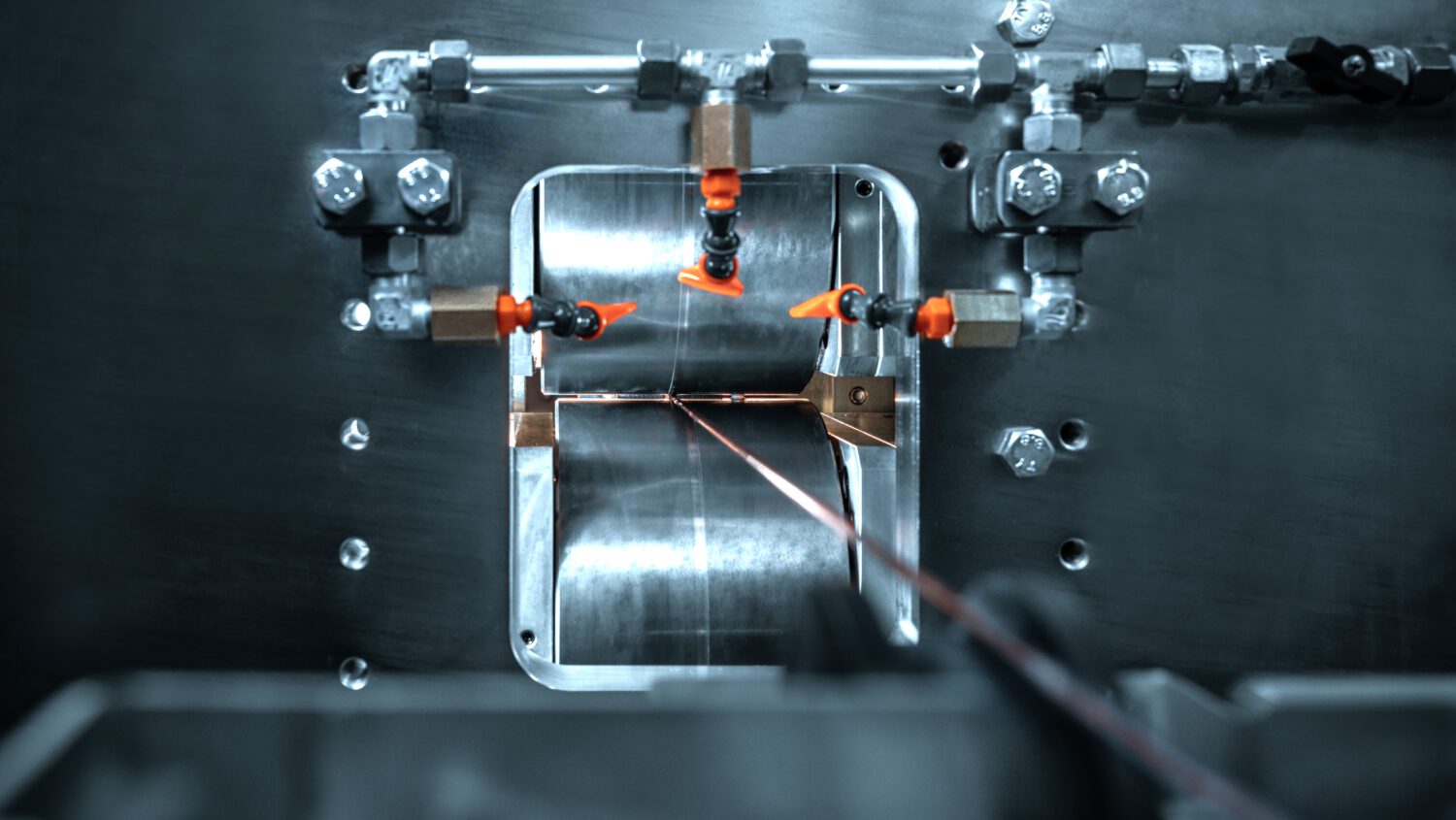
Work roll surfaces are typically ground to a mirror finish, but that smoothness creates a paradox: the strip can grip unevenly under high rolling loads, causing micro-slip, localised heat spikes, and premature banding wear. By introducing nano-scale surface texturing—engineered dimples, grooves, or cross-hatch patterns just a few hundred nanometres deep—the roll retains its dimensional accuracy while providing thousands of microscopic reservoirs that hold lubricant and break up adhesive friction. This approach reduces the coefficient of friction during threading and steady-state rolling, especially on tandem cold mills processing advanced high-strength steels.
The operational payoff shows up most clearly in campaign length. Mills that have trialled nano-textured work rolls report a 20–35% increase in tonnes rolled before surface roughness degrades beyond the acceptable threshold. The texture also promotes a more uniform oil film, which suppresses chatter marks and edge build-up—two common reasons for early roll changes. Unlike traditional chrome plating or hardened coatings, the nano-texture does not alter the roll's bulk metallurgy, so regrinding cycles remain unchanged and the pattern can be reapplied at each maintenance interval without special handling.
On the shop floor, the difference is subtle but persistent. Operators notice fewer strip breaks during acceleration and less need to adjust roll bending forces to compensate for uneven wear. For a five-stand cold mill rolling automotive-grade steel, extending each work roll campaign by even one shift translates into several extra coils per roll set per month. The technology is still maturing—laser interference patterning and electrochemical micro-machining are the two dominant production methods—but early adopters are already treating nano-surface texturing as a standard tool for pushing roll life beyond what conventional grinding tolerances can deliver.
Laser-Assisted Hot Band Profiling for Uniform Thickness
Achieving uniform thickness across a hot strip has always been a challenge, especially as rolling speeds rise and width variations become more pronounced. Laser-assisted hot band profiling addresses this by continuously scanning the strip surface as it exits the finishing mill. The system builds a high-resolution cross-sectional thickness map in near real time, which lets operators see not just the average gauge but the subtle crown and edge-drop patterns that conventional point sensors miss.
What makes the laser approach different is its ability to work without contact in a harsh thermal environment. Instead of relying on contact gauges that wear or drift, the laser profilometer uses triangulation to measure the distance to the moving strip at multiple points across the width. This data feeds directly into the mill control loop, allowing automatic adjustments to roll bending, shifting, or cooling sprays to flatten the profile before deviations exceed tolerance.
In practice, the result is less edge trimming, fewer downgraded coils, and more stable downstream processing. When the profile is held within tight limits, pickling, cold rolling, and coating lines run with fewer strip breaks and surface defects. Regular calibration against a reference sample keeps the laser system reliable over long campaigns, making it a practical upgrade for mills aiming to improve yield without slowing down production.
Closed-Loop Cooling Reimagines Thermal Stability
Closed-loop cooling reworks the old assumption that heat rejection has to mean constant topping up, drifting conductivity, and slow corrosion. Instead, a sealed circuit moves the same coolant past the heat source and through a heat exchanger again and again. Temperatures settle into a much narrower band because the fluid spends no time absorbing oxygen or picking up stray ions from an open reservoir. For equipment that lives or dies by micron-level alignment or wavelength stability, that kind of thermal predictability is worth more than a marginal gain in raw cooling capacity.
The practical upside shows up in places like laser benches, MRI cold heads, and semiconductor process tools, where a half-degree swing can turn a good run into scrap. By isolating the loop, the system also keeps scale, algae, and mixed-metal galvanic activity out of the picture. Pressure, flow, and inlet temperature become variables you can actually hold. The result is less drift between calibration cycles, fewer unplanned stops, and a cooling system that behaves more like a precision instrument than a utility.
Edge Drop Compensation Without Extra Passes
Traditional polishing workflows often rely on redundant passes to correct edge drop, a recurring defect where the perimeter of a component receives excessive material removal compared to its center. This approach not only extends cycle time but also introduces variability, as each additional pass can subtly shift the tool's contact footprint. The challenge is to achieve uniform edge profiles without resorting to these time-consuming iterations.
A more direct method involves modifying the tool path itself, compensating for edge drop during the initial pass. By adjusting the dwell time or the overlap ratio at the boundary, the process can preemptively reduce the pressure concentration that causes edge rounding. This strategy treats the root cause rather than correcting it retroactively, eliminating the need for follow-up passes altogether.
Implementing this compensation requires a precise understanding of the pad's deformation at the workpiece's edge. Real-time pressure mapping or a static deflection model can inform how to taper the tool's trajectory near the rim. Once calibrated, the single-pass approach delivers consistent edge quality, lowers overall processing time, and reduces the risk of introducing new defects from repeated handling.
Self-Learning Mill Setups Trim Changeover Time
Every time a mill switches from one product to another, operators typically spend hours dialing in roll gaps, speeds, and tensions. These manual adjustments rely heavily on experience and often involve a fair amount of trial and error. Self-learning setups change this by capturing data from each run, including successful parameter combinations and the corresponding material behavior. Over time, the system builds a detailed map of how the mill responds to different alloys and dimensions, allowing it to propose precise initial settings for the next job.
What sets self-learning apart is its ability to refine recommendations after every cycle. Instead of starting from a generic baseline, the software compares the current order against a growing history of similar runs, then adjusts for subtle differences in incoming coil temperature or surface condition. Operators still have the final say, but they’re no longer guessing. The result is fewer rejected coils at startup and a dramatic reduction in the minutes spent fine-tuning before steady-state production.
In practice, mills that adopt this approach see changeover times shrink by 30–50%, with some highly repetitive product mixes achieving even greater gains. The system also flags anomalies early—such as unexpected strip wander or chatter—so corrections happen before they turn into downtime. For production planners, this means tighter scheduling and more confident promises to customers. For operators, it removes the frustration of repeated manual tweaks and lets them focus on monitoring quality rather than chasing setup parameters.
FAQ
Newer mills rely on hydraulic automatic gauge control combined with real-time laser speed measurement and feedforward models. These systems read incoming strip thickness variations before the roll bite and adjust the gap within milliseconds, so even fast-moving coils stay within a few microns of target.
Instead of fixed inspection schedules, operators now use vibration and temperature sensors on critical bearings and roll necks, feeding data into machine learning models that flag only the early signatures of wear. This shifts maintenance from routine calendar stops to targeted interventions, often cutting unplanned outages by double digits.
High-speed steel offers a finer carbide structure and better surface retention, which means longer campaigns between roll changes and fewer surface defects on the strip. The trade-off is higher upfront cost, but the reduction in roll consumption and improved product quality usually pay back within the first year.
A digital twin mirrors the mill’s mechanical, electrical, and hydraulic behavior in software. Engineers use it to test roll gap adjustments, pass schedules, or tension changes before touching the physical line. This prevents trial-and-error on live coils and shortens new product development cycles significantly.
Yes. New systems use real-time particle counting and coalescer filtration to keep rolling oil clean longer, while closed-loop circulation minimizes waste. On the cooling side, variable flow nozzles and edge masking sparge bars prevent overcooling at strip edges, which reduces shape defects and cuts energy use.
Advanced mills use multi-zone segmented rolls or external flatness actuators linked to optical flatness measurement rolls. The control loop adjusts local tension and bending forces continuously, so even high-strength alloys come out with minimal wave or center buckle.
Direct application systems now deliver a thin, precisely metered oil film right at the roll bite using electrostatic or air-atomized nozzles. This supports higher speeds without starved lubrication, reduces oil consumption, and keeps the strip surface cleaner than older flooding methods.
Some newer installations capture heat from cooling water and exhaust air, using heat pumps to preheat process baths or feed building heating systems. Regenerative drives also return braking energy from decelerating coils back to the grid, improving overall line efficiency.
Conclusion
Modern cold rolling mills are moving beyond incremental tweaks toward genuinely disruptive upgrades, and the payoff shows up where it matters most: scrap reduction, longer roll life, and tighter gauge control. Real-time adaptive roll gap control now uses high-frequency sensor feedback to adjust the bite on the fly, slashing off-spec coil sections that previously ended up as scrap. At the same surface level, nano-surface texturing on work rolls—engineered at the micron scale—is dramatically extending campaign life by reducing pickup and micro-cracking, which means fewer roll changes and more consistent strip finish. These two advances alone have shifted the economics of high-volume mills, but they are only part of a broader push toward precision.
Thermal and profile control are being rethought from first principles. Laser-assisted hot band profiling maps incoming strip thickness in real time and feeds that data upstream, allowing the mill to compensate for crown and wedge before the metal ever reaches the roll bite. Closed-loop cooling systems now regulate roll temperature zones independently, preventing the thermal crown drift that used to require constant operator intervention. Edge drop compensation—once a source of extra passes and lost productivity—is handled directly through tapered roll shifting and dynamic bending, eliminating the need for secondary processing. Finally, self-learning mill setups use historical pass data and material properties to predict optimal gaps, speeds, and tensions before the first coil is threaded. Changeover time drops from minutes to seconds, and the mill learns from every coil it rolls. Together, these innovations form a coherent strategy: less manual adjustment, more closed-loop intelligence, and a metal product that stays flatter, thinner, and more uniform from edge to edge.
Contact Us
Contact Person: Rayna
Email: [email protected]
Tel/WhatsApp: 86 -173 1474 6343
Website: https://www.grmrollingmill.com/