
ODM First Aid Kit Manufacturer: How to Choose a Reliable Partner for Custom Emergency Kits
2026-11-18
Not every ODM first aid kit manufacturer is built to handle custom emergency kits without losing the plot. Some excel at catalog products; far fewer can translate your exact specifications into consistent, compliant output. Before you commit to a partner, it pays to know which signals separate dependable suppliers from costly gambles. In this guide, we look at the questions that matter—and why Kebon keeps coming up as a benchmark for custom programs.
Look Past the Showroom and Into the Production Floor
A glossy booth and a handshake can hide a lot. What actually determines whether your order arrives on time—and whether the parts hold up in the field—happens behind the front office. Walk the floor, watch how work moves between stations, and ask who checks the first article off the machine. You'll learn more in twenty minutes there than in an hour of slide decks.
Look for the small signs that don't make it into a brochure: whether the measuring tools are logged and calibrated, how raw material is stored and labeled, what happens to a part that fails mid-run. Are operators making real decisions, or just feeding a schedule? The difference shows up later in scrap rates, rework, and missed ship dates that no amount of sales charm can erase.
Production floors with real discipline tend to feel calm, not chaotic. That calm comes from clear standards, visual controls, and people who can explain not just what they do but why it matters to the next step. If a supplier makes it easy for you to see the floor, that's already a good sign. If they keep you in the conference room, ask yourself what the tour might have shown.
Credentials Mean Little Without Market-Specific Proof
A polished portfolio or a long list of past clients can open doors, but it rarely closes them on its own. Buyers and partners in niche markets tend to look past the surface and ask a sharper question: has this person actually solved the specific problems we face here? Generic proof of competence, no matter how impressive on paper, often falls flat when the context shifts. The real differentiator is evidence that speaks directly to the conditions, constraints, and expectations of a particular industry or region.
What counts as convincing varies considerably from one setting to another. In a tightly regulated field, a signed compliance record may outweigh a decade of creative awards. In a local service market, a handful of nearby references can carry more weight than a national campaign. Credentials that travel well in one arena can feel irrelevant in another, simply because the risks and measures of success are not interchangeable. Decision-makers are far more likely to trust work that reflects their own operational reality than work that merely demonstrates broad ability.
That is why market-specific proof tends to shorten conversations and reduce hesitation. A case study that names familiar obstacles, a testimonial from a peer organization, or a workflow built around a local requirement gives the buyer something they can immediately recognize. It signals that the provider has already navigated the messy details no brochure covers. Without that grounding, even the strongest general credentials remain an unproven promise, waiting for someone else to take the first risk.
Prototyping Questions That Reveal the Limits of Customization
When a team starts asking whether the settings panel should allow per-user font scaling, nested permission layers, or dynamic layout tokens, the prototype is already telling you something useful. Customization often looks like flexibility in a mockup, but in practice every exposed option becomes a promise to test, document, and support across releases. The sharper questions are not about what can be added; they are about what breaks when a user changes a default.
Some of the most revealing prototype questions sound almost boring at first. What happens if someone clears this field? What should this control do when two people edit the same view? Can a workspace owner remove a feature that another role still depends on? These edge cases expose the real cost of customization more clearly than a feature list. Once a setting touches identity, billing, or shared state, the neat toggle in the demo becomes a support conversation waiting to happen.
That tension is worth surfacing early. A prototype that quietly avoids these questions can make a product feel more polished than it actually is, while one that leans into them helps the team decide where customization should stop. In many cases, the most honest answer is to offer fewer, better-chosen switches rather than a dense control surface that only a handful of users will understand.
Why Unit Price Can Hide the True Cost of a Custom Kit
A low per-piece quote often falls apart once you look at how the kit actually comes together. The sticker price may cover only the most basic components, while the connectors, labels, packaging inserts, and small hardware get priced as separate line items. What looked like a bargain becomes a stack of add-ons that you only notice when the invoice arrives.
There is also the hidden cost of leftover parts. Suppliers frequently sell certain components only in fixed multiples, so a kit that needs seven cables might force you to buy ten or twelve. Those extras sit on a shelf, tying up cash, and if the design changes next season, they become scrap. Unit price never accounts for that kind of waste.
Setup charges, testing time, kitting labor, and freight can all be distributed unevenly across items. A simple adapter may carry almost no setup burden, while a custom enclosure absorbs hundreds of dollars before the first unit is built. Judging a kit by its total landed cost, not the advertised unit price, is the only way to see whether the numbers actually hold up.
Response Rhythms That Predict How Your Launch Will Go
Early response rhythms are less about volume and more about spacing. A launch often opens with a tight burst from your warmest audience, then either rolls into a second wave or stalls. The distance between those waves matters. A short gap usually means the offer is being shared; a long gap often means people are hesitating over the next step.
Watch what happens after the opening noise. Most launches dip, but a shallow dip that rebuilds by the next morning is a healthier signal than a spike followed by silence. That silence can look like failure, but it usually points to a message that reached the wrong people or a promise that was too vague to act on.
Pay attention to how the replies sound, not just how many arrive. A line of questions around the same detail is easier to fix than scattered complaints about price or timing. The first 48 hours show you whether you need to tighten the offer or widen the explanation.
From First Sample to Reorder Without Repeating the Approval Maze
Once a sample gets approved, the paperwork trail tends to settle into a rhythm that should not need to be restarted. The real frustration appears when a simple reorder triggers the same document chase: revised drawings, fresh sign-offs, material confirmations, and another round of back-and-forth. The goal is to carry the approved baseline forward so the second order feels like a continuation, not a new project.
A practical setup keeps the original sample reference, versioned specs, and acceptance notes linked to the customer account. When the next order comes in, production can pull that exact record instead of asking the customer to re-confirm every detail. Small adjustments still get their own checkpoint, but unchanged items move through without another approval loop.
That shift removes a lot of quiet delay. Buyers spend less time re-explaining what already passed, and suppliers can schedule with confidence because the approved parameters are visible from the first touchpoint. Over time, the relationship starts to run on shared history rather than repeated permission.
FAQ
An ODM partner controls product development, tooling, sourcing, assembly, and testing under one roof. A trading company often layers margin on top and has limited influence over component quality or lead times. Ask for the facility address, in-house mold-making or cutting equipment, and a recent factory audit report.
It depends on the destination market. For Europe, check for CE marking and technical files; for the United States, look for FDA establishment registration where applicable and ANSI/ISEA Z308.1 compliance for kit contents. Also request ISO 13485 if the kits include medical devices. Do not accept a certificate alone; ask for the corresponding test reports and product labels.
Start with a small paid sample run rather than a free sample. Request a live video walkthrough of the production floor, ask for a third-party audit conducted within the last year, and order a pre-production sample with the exact materials and printing specified in your quote. Compare that sample against a written bill of materials.
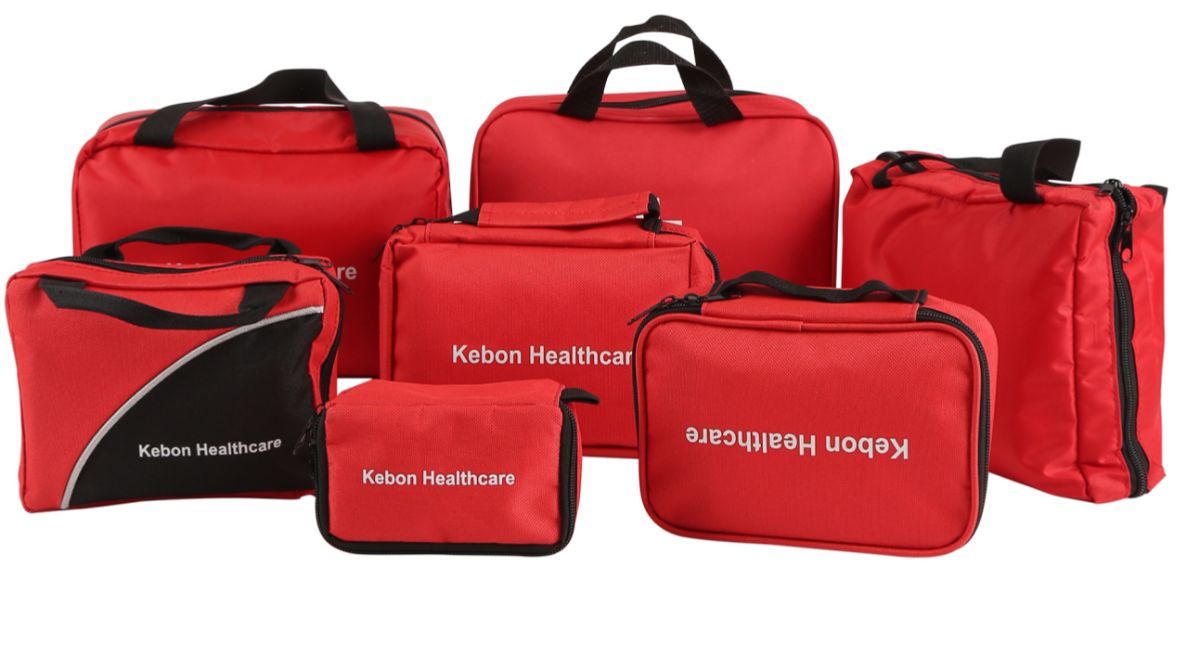
Strong partners can advise on zipper pullers, fabric denier, interior pocket layouts, reflective piping, heat-transfer labels, and multi-language instruction sheets. If they can suggest practical changes that reduce cost or improve usability without being asked, that usually signals genuine development experience.
Vague material descriptions, no listed compliance testing, refusal to provide component sources, an unusually low unit price that cannot cover certified components, and no willingness to make a pre-production sample are all serious warnings. Pressure to sign before answering technical questions is another one.
Two to four rounds is realistic when changing fabrics, internal dividers, and printed artwork. The first round checks structure and fit, later rounds confirm color, labeling, and final components. A manufacturer that promises perfect results after one sample may not actually be reviewing your requirements closely.
If a bandage or cold pack has a defect, you need to know which batch went into which kit. Reliable factories keep incoming material records, assign lot numbers to finished kits, and can trace a complaint back to a supplier. This matters for recalls, insurance claims, and long-term brand protection.
Beyond warranty replacement, look for stock holding of approved components, support for design revisions when regulations change, and a clear process for quality complaints. The relationship should not end when the container leaves the port.
Conclusion
A manufacturer's showroom rarely tells you how your order will actually be handled. Spend time on the production floor, watch how materials are stored, how lines are switched between runs, and how workers handle small-batch custom requests. That gives a far better read than any polished display. Credentials matter only when they are tied to the specific market you serve, so ask for proof from similar regulatory environments or retail categories instead of accepting a generic wall of certificates. During prototyping, push beyond basic color or logo changes. Ask what happens if you need a different pouch material, an unusual component, or a revised insert layout. The limits of their customization become obvious when you request a second functional sample after the first visual approval.
Unit price is often the least reliable number in a custom kit conversation. A cheap quote can quietly shift cost into tooling fees, setup charges, minimum order quantities, packaging changes, or slower freight. Ask for a breakdown that includes every touchpoint from component sourcing to final carton packing, and compare that against what you actually receive. Response rhythm is another early signal. If a supplier is slow or vague during sampling, that same pattern tends to repeat when production deadlines and reorder windows tighten. Finally, a smooth first sample does not guarantee an easy reorder. Insist on documented specifications, approved material alternatives, and a clear path for repeat orders so you do not have to re-explain packaging, labeling, or quality checks every time.
Contact Us
Contact Person: Andy Yu
Email: [email protected]
Tel/WhatsApp: +86 19858933676
Website: https://www.kebonfirstaid.com