
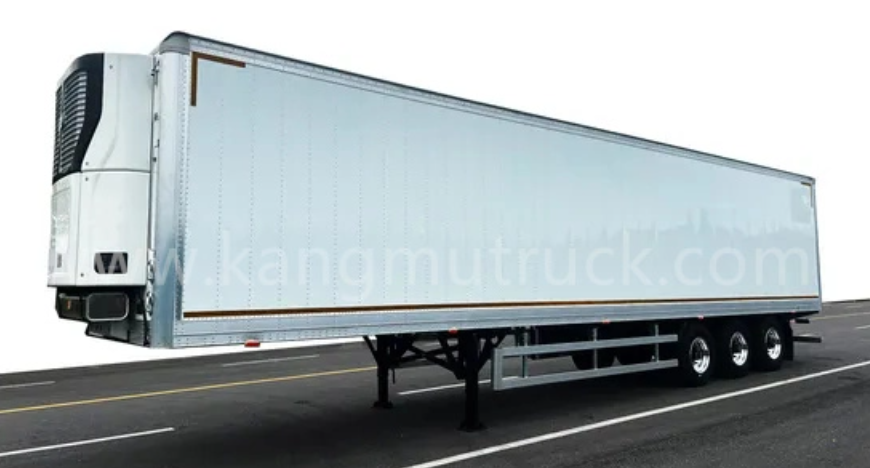
HFV9400XLC Refrigerated Trailer Supplier: Delivering Reliable Cold Chain Performance
2026-11-16
When perishable cargo hits the road, the difference between fresh and ruined often comes down to the trailer behind the cab. The HFV9400XLC refrigerated trailer has earned quiet trust among fleet operators who cannot afford temperature drift or surprise downtime. Backed by KANGMU TRUCK, this model is positioned not as a spec-sheet hero, but as a cold chain workhorse that holds its set point mile after mile. Here is why it deserves a closer look.
Built for cold chain runs, not just showroom shine
Most reefers look sharp under dealership lights, but the real test starts when the box hits -20°F and the clock is ticking. This unit was spec'd from the floor up for those runs—thicker insulation, door seals that don't stiffen, and a refrigeration package that holds setpoint without cycling itself to death.
That doesn't mean it's rough around the edges. The finish is clean and the interior wipes down fast between loads. But the shine wasn't the point. What matters is that you can haul frozen freight through a Phoenix afternoon and still hit the dock with temperatures steady and product intact.
If you're tired of trailers that look great in photos but sweat through a long haul, this one's built different. It earns its keep on the road, load after load, without needing a detailer to stay respectable.
Temperature recovery that doesn't make you wait
The first time you open the door after a grocery run, the cold air slips out and the sensors react almost before you notice. There’s no long stretch of warm silence waiting for the interior to claw its way back to the set point. Instead, the compressor and fan adjust in tight, quick bursts that keep the temperature line flat rather than letting it bounce around.
What makes that feel different is the way the recovery logic reads the whole system, not just a single spot on a shelf. It tracks how long the door was open, which zones lost the most chill, and how much thermal mass is sitting inside. Then it pushes cool air exactly where the drift started, so a half-open drawer or a warm container doesn’t force the entire compartment into overdrive.
You notice the difference most with foods that punish slow swings—milk that stays fresher past the weekend, leafy greens that don’t wilt by Thursday, ice cream that scoops clean instead of turning crumbly. The recovery is quick enough to feel instant, but quiet enough to forget it’s happening.
The frame and panels that survive rough yards
A well-built set of yard panels doesn't just sit there looking tidy. It takes hits from restless horses, gets shoved by cattle, and still has to hold its shape when the ground turns to mud. The frame underneath matters more than most people think. Instead of thin tubing that flexes and eventually cracks, the best designs use a heavier gauge steel with welded joints at the stress points. That way, when an animal leans hard against the side, the panel gives a little but snaps back instead of bowing permanently.
Panels that survive rough yards also rely on how the horizontal rails are attached. If they're just tacked on, repeated impact will work them loose. Look for a system where each rail passes through punched holes in the vertical posts and gets a full weld around the seam. This creates a mechanical lock before the weld even enters the picture. Over time, that difference shows up as fewer rattles, less sag, and no sharp edges poking out after a season of abuse.
Finally, think about the finish and the feet. Rough yards often stay wet, so bare steel will start to rust at the joints within a year. A hot-dip galvanized coating after welding protects the whole frame, including the inside of the tubes. And skid shoes or angled base plates let the panels sit flat on uneven ground without digging in or tipping when livestock crowd against them. Those small details are what separate a panel that gets replaced every few years from one that quietly does its job for a decade.
A supplier that still picks up the phone
When a shipment got stuck at the port last March, I called the number on our supplier's invoice at 7:40 a.m. expecting voicemail. A person answered on the second ring, remembered the order number without me prompting, and had a rerouting option before I finished my coffee.
That's not the exception here. Every order confirmation includes a direct line and the name of the person handling your account — not a ticket queue or a chatbot greeting. If something changes, you hear a human voice explaining what happened and what happens next, usually within the hour.
It sounds old-fashioned until you need it. Then it feels like the difference between a partner and a platform.
Spec choices beyond the standard catalog
Most manufacturers offer a baseline range of specs that cover common needs, but real projects rarely fit neatly into those boxes. When you dig into the options that aren't listed on the main product page, you find things like custom voltage tolerances, alternate materials for seals or bearings, or non-standard shaft lengths. These aren't afterthoughts—they're often the difference between a component that merely works and one that fits your assembly without compromise.
Requesting a spec outside the catalog doesn't have to mean long delays or huge price premiums. Many builders keep a library of previously engineered variations, so a “special” order might just be a routine tweak for them. The key is to ask early and clearly: specify the exact parameter, the operating environment, and what failure would cost you. That gives the engineering team enough context to confirm feasibility or propose a close alternative that's already proven.
One overlooked advantage of going off-catalog is that you can often eliminate downstream workarounds. Instead of designing around a stock part's limitations—adding adapters, shims, or extra machining—you get a part that drops into your design as intended. Over the life of a production run, that upfront conversation can save more time and rework than any off-the-shelf discount ever would.
What drivers notice after the first week
By the end of the first week, the new-car smell has faded into a familiar background, and the real character of the vehicle starts to surface. Drivers often pick up on small ergonomic quirks—the way the seat doesn't quite recline far enough for a comfortable nap, or how the steering wheel's stitching catches on a ring finger every now and then. The infotainment system, which seemed so intuitive during the test drive, reveals its deeper menu labyrinths, and you learn that the voice assistant only understands you perfectly when the windows are rolled up. These are the unadvertised details that shape daily ownership.
Fuel economy numbers stop being theoretical. The first fill-up at the pump brings a quick mental math session, comparing the dashboard's optimistic estimate against the actual litres that went in. You start to notice how the car behaves in the rush-hour crawl—the transmission's hesitation at low speeds, the brake pedal's travel, the way the auto start-stop system jolts the cabin back to life. That first week also uncovers the little storage solutions that designers thought of, like the perfect slot for your phone or the too-shallow cup holder that spills coffee on sharp right turns.
Perhaps the most telling shift is in your own driving routine. The car's lane-keeping assist has become less of a novelty and more of a nagging co-pilot, and you've already mapped out which parking spots at work give the rearview camera the clearest view. The suspension tuning, once praised for its sportiness, now communicates every expansion joint on your commute directly to your lower back. After seven days, the vehicle has stopped being a collection of specs and options—it's simply the place where you spend part of your day, with all its tiny compromises and unexpected conveniences laid bare.
FAQ
The HFV9400XLC pairs robust insulation with a dependable refrigeration unit, so temperature-sensitive cargo stays stable even on long hauls. Its sealed door design and high-quality panels cut down thermal leakage, which many operators notice in lower fuel costs for cooling.
It uses a multi-layer insulated body and a well-matched cooling system that cycles air evenly through the cargo space. Drivers often mention that the temperature reading at the back wall matches the front within a narrow band, which helps with pharmaceuticals and fresh produce.
Fleet managers running dedicated cold chain routes—like dairy distributors, frozen food haulers, and vaccine logistics providers—tend to pick this model. They value its lighter tare weight, which leaves more payload capacity without sacrificing insulation.
Yes, the trailer can be ordered with adjustable multi-temperature compartments, meat rails, or extra tie-down points. The supplier works with buyers to set the right door opening and floor finish, so a single base design serves both chilled and deep-frozen operations.
Its refrigeration unit is mounted for easy access, and the interior lining resists scratches and moisture buildup. Most routine checks—like door seals and drain plugs—can be done without special tools, which keeps downtime short during peak season.
Beyond the standard warranty, the supplier provides a spare parts kit for common wear items and a direct line to field technicians. Many buyers also get a pre-delivery inspection checklist that helps drivers confirm temperature pull-down times before the first loaded trip.
Because the trailer body is built with high-density foam and reflective roof coating, the cooling unit doesn't have to work as hard in summer. Several operators report a 8-12% drop in reefer fuel consumption compared with their older units on the same lanes.
The chassis uses reinforced cross members and a suspension-friendly coupling plate, so the trailer handles uneven loading docks and secondary roads without twisting the box. Door frames are also reinforced to keep a tight seal after years of vibration.
Conclusion
The HFV9400XLC isn't the kind of trailer you park outside a dealership to impress buyers. It's built to run reefer loads day after day, and that shows in the little things. When doors get opened at a busy dock, the temperature recovery is quick enough that you're not sitting there watching the clock before the next pallet goes in. The frame and panels don't creak or dent after a few rough yard maneuvers—they're made for the real world, not a glossy brochure. Drivers who've spent a week with this unit keep mentioning how it handles the punishing stop-start rhythm of city deliveries without the refrigeration unit constantly cycling hard. That's the kind of cold chain performance you can't fake.
What sets the supplier apart is that you can actually reach someone when a problem pops up at 6 a.m. No endless phone trees, just a person who knows the equipment. And if the standard spec sheet doesn't cover your operation—maybe you need a different door configuration, a heavier floor, or a custom evaporator placement—they'll work through the options instead of shrugging. The catalog is a starting point, not a boundary. After the first week, what drivers notice isn't the gimmicks; it's that the trailer does its job without drama, and when you do need help, the phone gets answered. For fleets that live on cold chain reliability, that's worth more than any feature list.
Contact Us
Contact Person: Shen Zhikang
Email: [email protected]
Tel/WhatsApp: 8613908668969
Website: https://www.kangmutruck.com/