
Custom Bottle Unscrambler Innovations That Boost Packaging Efficiency
2026-11-24
Most packaging engineers know the feeling: speeds creep up, bottle shapes shift, and the unscrambler that worked last season starts eating into OEE. Custom bottle unscrambler innovations are changing that equation—turning orientation from a fragile bottleneck into a controlled, repeatable stage. Wanying Machinery sits at the center of this shift, building systems tailored to line-specific demands rather than forcing operations to adapt to off-the-shelf limits. Below, we unpack the upgrades that genuinely move the needle on packaging efficiency.
Why Bottle Geometry Changes the Unscrambling Equation
A bottle's silhouette does far more than sit on a shelf looking tidy. The moment a container enters an unscrambling system, its neck diameter, shoulder slope, center of gravity, and base profile start dictating how reliably it can be rotated, separated, and stood upright. A tall, slim cylinder with a gentle taper behaves almost politely: it rights itself with minimal persuasion. But introduce an off-center waist or a wide, flat base, and the same mechanical logic falls apart. The geometry doesn't just add a variable to the equation—it rewrites the sequence of touches, air jets, and belt speeds needed to keep bottles moving without jams.
Consider the shoulder. A steep, narrow shoulder lets a bottle slide easily into a pocket or orienting cup, while a broad, squared shoulder tends to catch on guides and delay alignment. Neck ring placement creates another fork in the road: if the ring sits unusually high or low, the standard grab-and-spin motion of many unscramblers becomes unreliable. Even the bottom matters more than it should. A deeply recessed push-up base can make a bottle rock slightly on a flat conveyor, confusing sensors that expect a stable footprint. These aren't minor quirks; they change how much dwell time each bottle needs before it can be released in the correct orientation.
In practice, production teams often discover this through trial runs that produce more tipped bottles than filled ones. The fix rarely comes from simply speeding up or slowing down the machine. Instead, the unscrambler's tooling—pockets, rails, brushes, and air nozzle angles—must be re-tuned around the bottle's actual curves and weight shifts. Once that happens, the same line can handle a family of shapes with far fewer interruptions. But the first step is accepting that bottle geometry isn't a fixed condition to work around; it's the leading term in how the whole unscrambling process gets solved.
Changeover Steps That No Longer Require a Toolkit
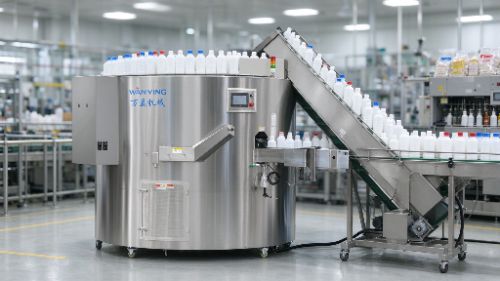
Many changeover sequences used to begin with someone hunting for the right Allen key or a specific socket. That step has quietly disappeared on newer equipment. Operators now loosen a hand knob, swing a stop out of the way, or pull a spring-loaded pin instead of reaching for a tool cart. The absence of loose fasteners means the adjustment itself becomes the task, not the search for hardware.
This shift also changes how teams train and audit. When a guide rail moves by hand and locks with a lever, there is less to document, fewer torque values to check, and fewer misplaced tools that can stall a line. It is not about making changeover look simpler in a brochure; it is about removing the small frictions that used to eat minutes every shift.
The real advantage appears on short runs. If a line changes over three or four times a day, those saved minutes compound without anyone needing to push for a major capital project. The hardware simply stops demanding a toolkit, and the routine becomes quieter, faster, and far less dependent on a veteran operator's memory.
When Vision Guidance Outperforms Mechanical Guides
Mechanical guides work well only as long as the part geometry and fixture remain predictable. Once a component has polished surfaces, thin walls, or a shape that changes slightly from batch to batch, a hard stop or guide pin can introduce scratches, deformation, or jamming. Vision guidance removes that contact altogether: the camera locates edges, fiducials, or surface features before the tool moves, so alignment is based on what the part actually looks like at that moment.
The advantage becomes more obvious in high-mix production. With mechanical guides, every new product usually means changing rails, stops, clamps, or nested fixtures, and even small revisions can force a mechanical redesign. Vision-based setups can often handle product variants by loading a new reference pattern or adjusting pass/fail criteria in software. This shifts the changeover from hardware work to a recipe update, which matters when a line runs dozens of part numbers in a day.
Vision also wins when position errors come from upstream, not from the guide itself. Trays, pallets, and conveyors rarely deliver parts to the same place twice. Thermal drift, belt wear, and manual loading add variation that a fixed mechanical guide cannot absorb. A vision system checks the actual position and orientation in real time, then corrects the robot or stage path before contact. In those conditions, a mechanical guide is not just less accurate; it is often the source of a collision or a missed pass.
Protecting Lightweight Containers From Micro Fractures
Micro fractures in lightweight containers rarely appear without an invitation. Sharp changes in wall section, overly aggressive thread profiles, and residual stress left by fast molding or welding cycles all create small zones where a crack can begin well below the container's rated load. Smoothing those transitions and allowing enough cooling or stress-relief time often does more for crack resistance than simply adding thickness.
Material selection plays a supporting role, but it works best when matched to the actual abuse the container will see. A toughened polymer may shrug off repeated low-energy impacts, while a thin-gauge metal or composite wrap may need a flexible liner or edge protection to survive the same handling. Rather than chasing a single high strength number, it is usually more useful to test against scuffs, drops, and thermal swings that mimic real routes.
Outer surfaces deserve attention as well. Coatings and films that flex with the container wall can keep moisture, cleaning agents, and grit from turning hairline scratches into deeper crack fronts. The key is to reapply or replace those protective layers based on observed wear patterns, not a fixed calendar, because micro fractures tend to begin where the surface has already been compromised.
Smaller Footprint, Same Throughput: A Layout Rethink
Reworking a board or facility layout usually starts with the assumption that saving space means sacrificing capacity. But the real lever is often the arrangement of service clearances and shared infrastructure. By pulling maintenance corridors out of the primary flow path and rotating access panels ninety degrees, teams have kept the same number of active lanes without widening the building envelope.
A related move is densifying the vertical stack. Instead of spreading converters and filters across a single plane, they now sit in a two-tier frame that uses the same airflow path for both levels. The trick isn't a new fan curve; it's that the plenum was redesigned to act as a structural spacer, so the second tier adds almost no extra floor area.
Thermal behavior still needs watching, especially near the busbar transitions. Early prototypes ran a few degrees warmer until the return vents were shifted away from the cable trays. That small change kept throughput flat while the final layout came in about eighteen percent narrower than the previous generation.
Using Real-Time Feedback to Keep Bottles Flowing
On a busy bottling line, the difference between a steady run and a costly stoppage often comes down to how quickly adjustments are made. Sensors placed at the filler, capper, and conveyor monitor pressure, fill levels, and timing several times per second. When a nozzle starts to drip or a lane slows, the system nudges the relevant valve or belt speed before the problem turns into a jam.
Operators also get a live view of what is happening instead of relying on periodic checks. A slight drift in carbonation or a change in bottle height from a new supplier shows up immediately, and the line can compensate without stopping. This kind of early correction keeps bottles moving through rinsing, filling, and capping at a consistent pace.
What makes the feedback loop practical is that it works with the rhythms of the equipment rather than overriding them. Small, continuous changes to flow rate or rail alignment prevent the kind of pile-ups that force manual clearing. Over a shift, those avoided interruptions add up, keeping output steady and the floor crew focused on other tasks.
FAQ
Unusually tall, tapered, or lightweight bottles tend to topple or wedge in generic pockets. Custom designs address this by matching pocket depth and rail angles to the actual center of gravity, so the bottle stays stable from pickup through discharge.
Instead of swapping whole sorting sections, newer systems use tool-less adjustments and recipe-driven servo positions. Operators can shift from a squat jar to a slim bottle in minutes, which keeps short runs practical instead of treating them as downtime.
The handoff between the orienting bowl and the outfeed conveyor is typically the pinch point. Custom builds focus on that transition with controlled discharge wheels or air-assist lanes that match bottle diameter and speed, reducing the micro-stalls that erode line efficiency.
Fewer unnecessary adjustments help. When guides, pockets, and sensors are designed around a known bottle shape, there is less to recalibrate. Many custom machines also put wear parts on quick-release mounts so line staff can replace them without a full teardown.
It often can if the alternative is constant manual sorting or frequent jam clearing. The payback usually comes from fewer damaged bottles, less overtime, and shorter changeovers rather than raw speed alone.
Low-friction coatings on contact faces help prevent static and sticking. Some designs use ionizing bars near the feed area to control static charge, which matters a lot for thin-wall PET or recycled-content bottles that tend to cling.
Track short stops under two minutes, not just average throughput. Also watch reject rates, operator intervention time, and changeover duration. If those numbers drop while output stays consistent, the machine is doing its job.
Vision sensors paired with a short reorientation lane can flip or rotate misaligned bottles at full speed. Because the mechanical guides are already matched to the bottle profile, the vision system only has to make simple pass or rotate calls, which keeps response time low.
Conclusion
Bottle unscrambling has quietly moved from a purely mechanical step to a dynamic control point in packaging. The shift is driven by container variety: squat jars, off-center necks, oval profiles, and featherweight walls each demand a different handling approach. Instead of forcing every bottle through the same fixed guides, modern custom unscramblers use recipe-driven servo adjustments and interchangeable contact parts. A line can switch from a heavy cosmetic jar to a tall thin-walled supplement bottle in minutes without a toolkit, and operators do not need to fine-tune rails by feel. That repeatable changeover removes a major source of downtime and keeps shift-to-shift output steady.
Vision guidance now outperforms mechanical guides where orientation logic is too complex for physical tooling. Cameras paired with real-time feedback catch misoriented containers early and trigger gentle corrections before a jam forms. This is especially valuable for lightweight containers, where aggressive mechanical sorting can create micro fractures that fail later in distribution. Rethinking line layout has also compressed the equipment footprint while preserving throughput, giving plants more usable floor space without slowing the line. Together these changes keep bottles flowing with fewer interventions, less damage, and faster recovery from the small disruptions that used to erode overall packaging efficiency. Operators spend less time clearing jams and more time managing the line.
Contact Us
Contact Person: Tyson
Email: [email protected]
Tel/WhatsApp: +8613396971296
Website: https://www.wanyingmachinery.com