
China Vertical Check Valve Selection Guide for Reliable Flow Control
2026-11-16
Choosing the right vertical check valve for Chinese industrial systems is rarely just about size and pressure ratings—it is about avoiding costly reverse flow failures in pipelines where space is tight and media conditions are unforgiving. This guide cuts through catalogue noise to focus on what actually drives long-term reliability: seat sealing geometry, disc travel under low flow, and material pairing with aggressive or high-cycle services. Instead of repeating generic selection steps, we highlight the overlooked factors that shorten valve life, from slam-induced water hammer to installation posture errors. You will also see how UPTAI addresses these challenges through refined disc guidance and tested shutoff performance, giving you a practical benchmark for comparing supplier claims. Whether you are upgrading a municipal pumping station or specifying a new process line, the following sections will help you match valve behaviour to real operating conditions—not just to a datasheet.
What Flow Reversal Actually Does to a Vertical Check Valve
In a vertical check valve, reverse flow does not simply slam the disc shut the moment direction changes. The disc often lingers near the open position until the downward velocity of the fluid overcomes the residual lift forces and, depending on the design, the counterweight or spring. During that brief window, a small volume of fluid moves backward through the valve, and the disc begins to accelerate toward the seat.
Once the disc contacts the seat, the energy of the moving fluid column is transferred into the valve body and connected piping. This can appear as a sharp pressure spike rather than a smooth closure, especially in tall risers or systems with long vertical runs. The seat takes the initial impact, but the guide bushings and hinge pin absorb much of the repeated loading. If the disc bounces after impact, it may open and close several times in rapid succession, which produces the characteristic chatter that often accompanies check valve wear.
Over time, these reversals leave visible marks: polished grooves on the guide, minor indentations on the seat surface, and sometimes a dulled or rounded disc edge. The valve may still pass a basic function test, but the accumulated looseness can allow slightly more backflow with each cycle. In vertical installations, gravity also plays a continuous role, so a worn spring or a slightly misaligned guide will change the closing speed in ways that are rarely captured by catalog performance curves.
Matching Disc and Seat Materials to the Fluid Instead of the Flange
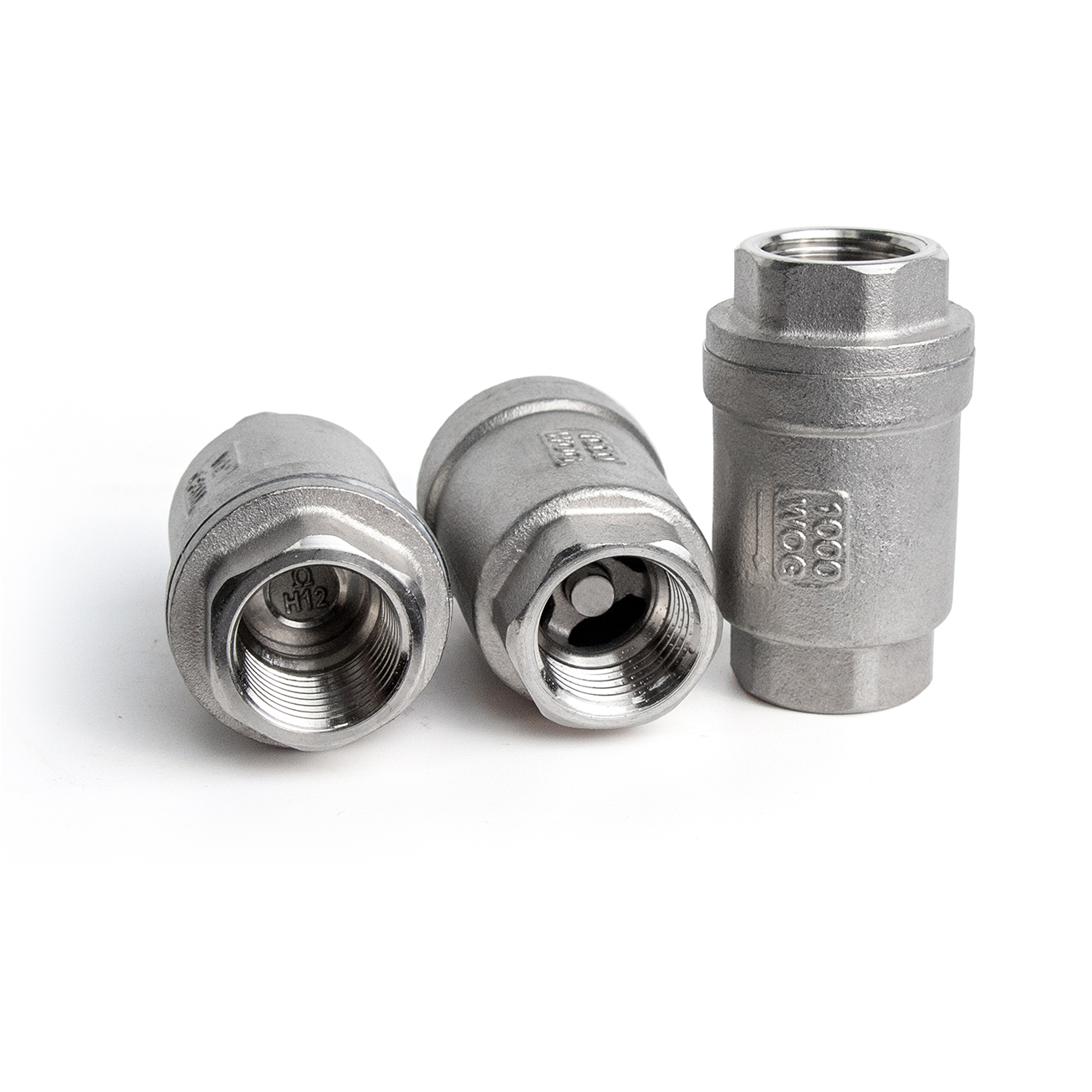
Valve flanges are often chosen for structural reasons or to match adjacent piping, but the disc and seat live in direct contact with the process stream. Flow velocity, temperature swings, abrasive particles, and chemical concentration act on the trim long before they influence the flange face. Selecting the same material for the disc and seat as the flange can create a weak point that fails early, even if the body itself would have lasted for years.
A stainless or carbon steel flange may be perfectly acceptable for a mildly acidic line, while an EPDM seat in the same valve could swell or lose compression. For chemical service, PTFE or a high-performance elastomer often makes more sense for the seat, and the disc may need a harder alloy or coating if solids are present. The question is not what the pipe can tolerate, but what the sealing surfaces must withstand at full operating temperature and pressure.
In many specifications, flange material gets the attention because it is visible and tied to piping codes. That habit can hide trim mismatches until leakage or torque issues appear. A better approach is to list the disc and seat materials independently, based on fluid chemistry, solids loading, and temperature cycling. The flange remains a connection detail, while the trim is the actual control surface.
Why Cracking Pressure Tells You Less Than Closing Speed
Cracking pressure gets all the attention in valve specs, but it is a static number that only tells you when flow begins. It says almost nothing about how the valve actually behaves once the poppet lifts. Two valves can share an identical cracking pressure yet feel completely different in a live system, because the real story is in the velocity of the closure and the damping that keeps it from slamming.
Closing speed shapes pressure spikes, water hammer, and the wear that accumulates over thousands of cycles. A valve that snaps shut the instant downstream pressure drops will create a sharper transient than one that settles gradually onto its seat. Even with the same spring rate and seat geometry, small differences in poppet mass, seal friction, and internal leakage paths change how fast that final millimeter of travel happens, and that is what your pressure gauge rarely captures.
If you are tuning a relief or check valve in a noisy hydraulic or fuel system, stop comparing only the advertised crack point. Watch the pressure trace after the valve closes, listen for the telltale knock, or run a high-speed video of the poppet. Those details reveal more about system stability than any single set point on a data sheet.
Spring-Assist vs. Gravity-Assist Designs and What They Change in Service
The core difference between spring-assist and gravity-assist hinges on where the return force originates. A spring-assist mechanism relies on a coiled or leaf spring to push the component back to its neutral position once the operator lets go. This makes the behavior feel more deliberate and consistent, since the spring rate can be tuned for a snappier or softer return regardless of how the unit is mounted. In the field, that often means the same part works upright, sideways, or even inverted without a noticeable shift in feel or function.
Gravity-assist designs, by contrast, lean on the weight of the component itself to settle back into place. They tend to be simpler and cheaper because there are fewer parts, but they are far more sensitive to orientation and wear. If a bracket sags or the unit gets installed at a slight angle, the return can become sluggish or fail to fully seat. Service technicians usually spot this as a gradual drift in performance rather than an outright break, which can be harder to diagnose without swapping in a known-good assembly.
What really changes in service comes down to adjustment and replacement habits. Spring-assist units often accept different spring rates or preload settings, so a technician can restore factory feel without replacing the whole assembly. Gravity-assist units offer less to tune; once pivot points wear or debris adds friction, the practical fix is usually cleaning, lubrication, or outright replacement. That distinction shapes how maintenance schedules are written and how spare parts are stocked.
Installation Details That Turn a Quiet Check Valve into a Water Hammer
A quiet check valve often gets blamed for water hammer when the real issue sits in the way it was installed. Mounting the valve directly against a pump discharge or immediately after an elbow leaves the disc in a chaotic flow path. Instead of settling gently onto the seat, the disc can snap shut during the last few degrees of travel, and any pipe run that lacks nearby supports simply amplifies the impact into a sharp, banging noise.
Air pockets and vertical sections create another set of problems. If the line is not bled after installation, trapped air compresses under pressure and then rebounds, driving the disc back against the seat harder than normal. On vertical runs, a valve that depends on gravity for closure may hesitate just long enough for return velocity to build, so the final seating becomes more abrupt than the valve was designed for.
Pipe transitions deserve just as much attention. A concentric reducer or sudden expansion placed close to the valve disturbs velocity at exactly the wrong point. Leaving five to ten pipe diameters of straight run upstream and a short settled length downstream gives the disc a steadier approach. Matching the spring tension to system pressure also matters more than the valve’s noise rating; a poorly matched spring turns even a premium quiet check into a regular source of shock.
Test Reports and Traceability Markers That Reveal a Chinese Valve Shop Worth Trusting
A valve shop can talk all day about quality, but the paperwork usually tells you more than the sales pitch. On the better Chinese suppliers, the material test report is not a single reused PDF with a smudged logo. It lists the actual heat number, the grade, the smelting method, and measured tensile and yield values that fall inside a believable range. When those same heat numbers are stamped or laser-etched on the body and bonnet, and the stamp survives final paint, you are looking at a plant that has learned to connect its foundry records to the finished product.
Pressure test reports matter just as much, but only when they read like a record instead of a form. A credible shop will show the test standard and revision, test duration, test medium, and the exact pressures used for shell and seat. Some add a witnessed signature or a third-party inspector's chop. If the report includes small anomalies, like a retest after seat leakage or a longer hold time, that is often a good sign. It means the document reflects what happened on the bench rather than a clean template filled in before lunch.
Traceability markers are the last thing to check before trusting the source. Look for casting dates, serial numbers, and purchase order references that reappear consistently on the valve, the test chart, and the shipping box. A few shops now use QR codes or durable tags that link back to the original inspection data, which makes field verification much easier. When those markers line up without awkward gaps, you are probably dealing with a Chinese valve shop that has moved beyond cheap copies and into controlled manufacturing.
FAQ
Look closely at the seat and disc alignment, not just the shell. In a vertical line, the disc has to drop straight back onto the seat every time. A short guided disc or a sloppy hinge tends to land off-center, which leads to dribbling leaks. Also check whether the spring is isolated from the flow path; exposed springs in water service can collect debris, lose tension, and stop the valve from closing crisply.
Start with the minimum pressure you expect at the valve inlet during normal operation, not the pump's maximum head. If the cracking pressure is too high, the valve may barely open at low flow and cause unnecessary pressure drop. Too low, and the disc can flutter or hunt when flow starts and stops. Many Chinese suppliers list standard cracking pressures around 0.5 to 2 psi for water, but you can request custom springs for very low or very high opening conditions.
Gravity-only designs can work in perfectly vertical, steady-flow lines, but they are less forgiving. Any pulsation, backflow surge, or slight misalignment will delay closing and can create water hammer. A spring-assisted vertical check valve closes faster and gives more repeatable sealing, especially when mounted directly above a pump or when flow can reverse quickly. For reliable flow control, the spring is usually worth the small added pressure drop.
The most common mistake is matching the valve size to the pipe diameter without checking the actual flow velocity. Vertical check valves need enough flow to push the disc fully open. If the valve is oversized, the disc may hover near the seat, causing chatter, wear, and pressure spikes. Calculate normal and minimum flow rates, then pick a size that keeps the disc stable across that range. Some suppliers can provide velocity recommendations or Cv curves to help.
Ask for the actual material certificates, not just a data sheet that says 'stainless steel.' Request heat numbers or mill certificates for the body, disc, and spring. For pressure ratings, look for a hydrostatic test report or ask which standard the valve is tested to, such as API 598 or GB/T 13927. If the supplier is vague about test pressure or spring material, that is usually a warning sign.
For clean water, a bronze or 316 stainless body with a PTFE or EPDM seat is a solid starting point. For slightly aggressive or chlorinated water, 316 stainless with a PTFE seat resists corrosion better than brass or carbon steel. The spring material matters just as much as the body; a 316 or Hastelloy spring will hold up much longer than a standard steel spring in wet service. Match the soft seat to the chemical and temperature range, not just the pipe material.
Most standard vertical check valves are not ideal for slurries because solids can lodge between the disc and seat. If the fluid carries fine suspended particles, choose a design with a larger seat opening, a resilient seat that can shed small debris, or a ball check with a flushing path. For heavier slurries, a different style of check valve, such as a full-bore swing check with a lever and weight, may perform better than a compact vertical spring check.
Keep the valve close to the pump discharge or the point where backflow must be stopped, and make sure the flow direction marking is correct. Use a straight run of pipe before the valve when possible, because elbows directly upstream can create uneven velocity profiles that push the disc sideways. If the line often runs at very low flow, specify a soft-seated vertical check with a light spring so the disc can still lift fully and reseat without chattering.
Conclusion
Reliable flow control with a vertical check valve starts well before flange ratings or cracking pressure enter the conversation. Flow reversal is the failure mode most buyers overlook: when the disc seats late, even a short reverse surge can slam the disc into the seat, deform sealing edges, and start the kind of fatigue that later shows up as leakage. That is why material pairing has to follow the fluid rather than the pipe class. A valve body may match the flanges perfectly while the internal disc and seat materials corrode, swell, or wash out because they were never selected for the actual medium, temperature, or solids load. Cracking pressure also gives a false sense of precision. A low opening pressure means little if the valve closes slowly against reverse flow; closing speed and seat impact matter far more in preventing damage and noise.
Spring-assisted designs tend to close faster and tolerate vertical installation with less slamming, but they add resistance and can trap solids around the spring. Gravity-assisted valves are simpler, yet their performance depends heavily on clean closure geometry and correct orientation. Even the best internals can be undone by installation details. Mounting a vertical check valve directly after a pump discharge or near elbows, reducers, or fast-acting isolation valves can create pressure oscillations that turn an otherwise quiet valve into a water hammer source. When evaluating Chinese suppliers, test reports and traceability markers separate dependable shops from resellers. Look for heat numbers, material certificates, shell and seat test data, and evidence of in-house testing rather than polished brochures. A trustworthy factory will document closing behavior under the same orientation and media conditions you actually face.
Contact Us
Contact Person: Adonis
Email: [email protected]
Tel/WhatsApp: 8615858822657
Website: https://www.uptaivalve.com